There’s a special kind of pain in admitting you were wrong.
Not just wrong in theory — wrong in time, energy, money, emotion.
You’ve invested months into a project that isn’t working.
Stayed in a relationship that feels heavier than it should.
Held onto a stock that keeps falling because “it’ll recover.”
And somewhere in your head, a voice says:
I’ve already put so much into this. I can’t walk away now.
That voice has a name.
It’s called the sunk cost fallacy.
What is a Sunk Cost?
A sunk cost is any cost that has already been incurred and cannot be recovered.
Money spent.
Time invested.
Effort exhausted.
In pure economic theory, sunk costs should not affect future decisions. Rational decision-making says:
The only thing that matters is future costs and future benefits.
If something isn’t worth it going forward, you should stop — regardless of what you’ve already invested.
But humans don’t work like spreadsheets.
Why We Fall For It
The sunk cost fallacy happens when we continue something because of what we’ve already invested — even when stopping would be smarter.
Why?
Because walking away feels like accepting a loss.
And psychologically, losses hurt more than gains feel good. Behavioral economists call this loss aversion — we experience the pain of losing roughly twice as intensely as the pleasure of gaining.
Quitting doesn’t just mean changing direction.
It means admitting the past investment won’t pay off.
That’s emotionally expensive.
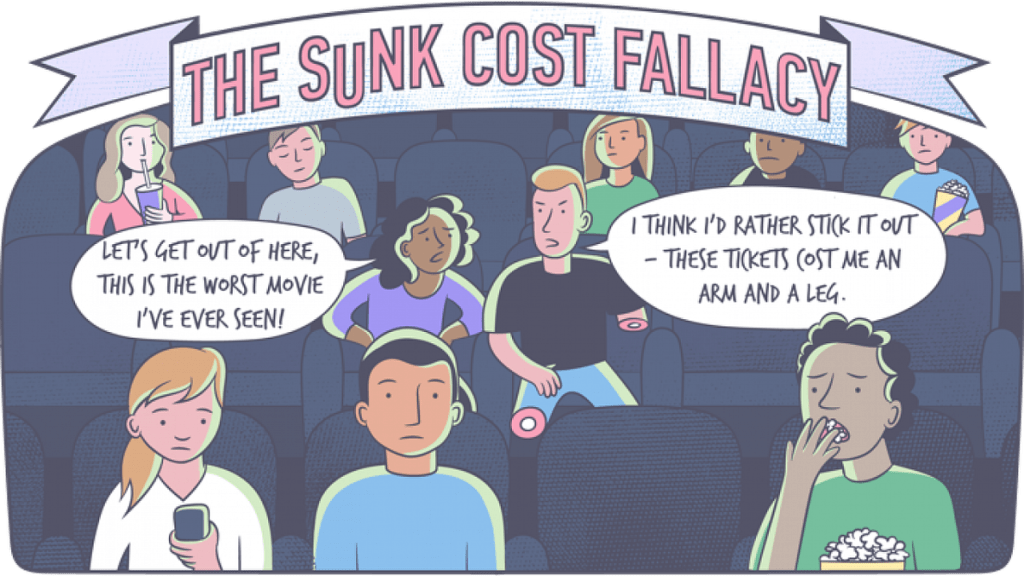
The Classic Example: Movie Tickets
You buy a ₹500 movie ticket.
Halfway through, the movie is terrible.
From a rational perspective, staying won’t get your ₹500 back. The money is gone whether you leave or not.
The only question should be:
Will I enjoy the next hour?
But most people stay.
Why? Because leaving feels like “wasting” the ticket — even though staying wastes your time.
That’s the sunk cost fallacy in its simplest form.
The Emotional Version
The most powerful sunk costs aren’t financial. They’re emotional.
Time in a relationship.
Years in a degree.
Energy spent building an identity around something.
You tell yourself:
- “I’ve come this far.”
- “I can’t quit now.”
- “It would all have been for nothing.”
But here’s the uncomfortable truth:
Past effort does not justify future suffering.
Economics would say: evaluate from today onward.
Your heart says: but look at everything I’ve already given.
And that’s where the tension lives.
How this Bias Shapes Economics
The sunk cost fallacy isn’t just personal — it’s systemic.
Governments delay structural reforms because they’ve long defended outdated policies. Companies stick to declining industries because they’ve built entire supply chains around them. Financial bubbles inflate because investors don’t want to accept early losses.
On a macro level, this bias slows adaptation. Economies hold onto inefficient systems longer than they should.
Sometimes stagnation isn’t caused by lack of opportunity.
It’s caused by refusal to release the past.
Change requires admitting that previous investments — financial, political, emotional — won’t deliver what was promised.
And that’s hard at any scale.
The Only Question that Matters
There’s one brutally clarifying question economists suggest:
If I were starting today with no prior investment, would I choose this again?
If the answer is no, the rational decision is to walk away.
Not because the past didn’t matter.
But because the past is unrecoverable.
The sunk cost fallacy tricks us into protecting what’s already gone instead of protecting what’s still possible.
And that’s the real cost.
The Real Lesson
Letting go doesn’t mean the investment meant nothing. It means you’ve learned from it.
Economics doesn’t dismiss the past — it simply refuses to let it dominate the future.
We can’t reclaim sunk costs.
But we can stop adding to them.
And maybe that’s what makes this bias so human.
The hardest decisions aren’t about choosing the best option.
They’re about accepting that the worst cost has already been paid.
 The Econ Odyssey
Leave a comment