Every boom feels different while you’re living through it.
Jobs are plentiful. Spending feels easy. Investments rise. There’s a quiet confidence that things are finally working.
And then — almost without warning — it ends.
Layoffs start. Markets wobble. Prices feel heavier. The same people who were optimistic six months ago begin asking, “What went wrong?”
The uncomfortable truth is this: nothing necessarily went wrong.
Booms don’t end because economies fail. They end because economies move in cycles.
What is the Business Cycle?
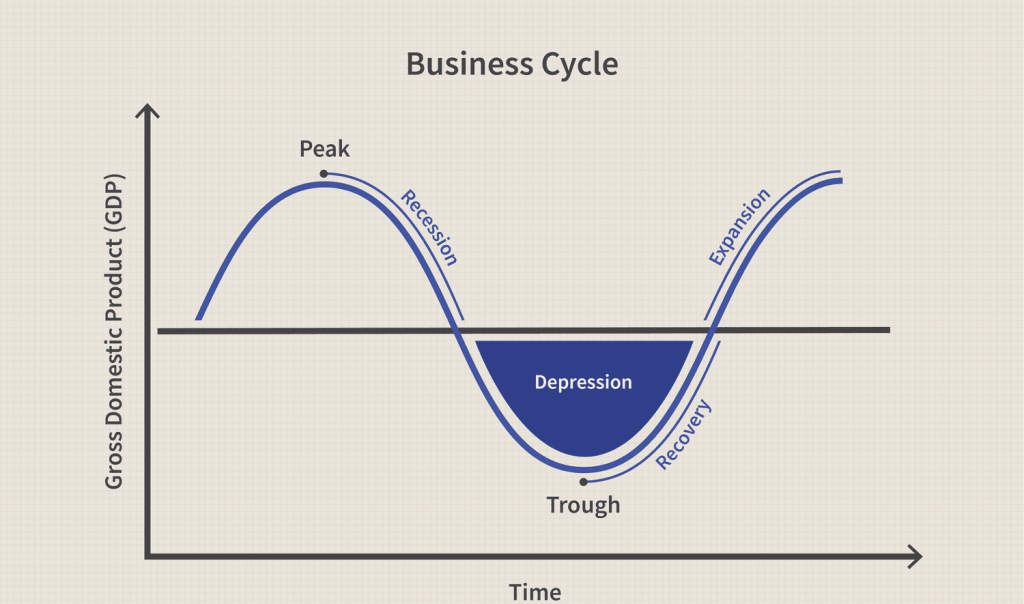
The business cycle is the natural rhythm of the economy: a repeating pattern of expansion, peak, contraction, and recovery.
It’s not a straight line upward. It’s more like a wave.
- Expansion: Output rises, jobs increase, incomes grow, confidence is high.
- Peak: The economy is running near full capacity. Growth slows. Pressure builds.
- Contraction (Recession): Spending falls, businesses cut back, unemployment rises.
- Recovery: Demand slowly returns, confidence rebuilds, and growth resumes.
Every modern economy moves through this cycle. The timing changes. The causes differ. But the pattern persists.
Why Booms Begin in the First Place?
Booms usually start with optimism — and optimism is powerful.
New technology, low interest rates, government stimulus, or post-crisis recovery can kick-start growth. Businesses invest. Consumers spend. Credit flows easily.
Growth feeds on itself:
- More spending → more production
- More production → more jobs
- More jobs → more income
- More income → even more spending
For a while, it feels sustainable. It feels earned. It feels permanent.
But that’s where the trouble begins.
The Seeds of the Bust Are Planted in the Boom…
Booms don’t collapse despite growth — they collapse because of unchecked growth.
Here’s what typically happens:
1. Overconfidence sets in
When things go well for long enough, risk feels smaller than it actually is. Businesses borrow more. Investors chase higher returns. Consumers stretch budgets.
Everyone assumes tomorrow will look like today — or better.
2. Resources get stretched
Labour markets tighten. Factories run at capacity. Housing demand outpaces supply. When the economy runs too “hot,” costs start rising.
This is where inflation often enters the picture.
3. Debt quietly builds up
Easy credit fuels booms — but debt doesn’t disappear when growth slows. Once incomes stop rising as fast, repayment becomes harder.
Debt turns from fuel into friction.
Why Policymakers Step In (Sometimes making it Worse)
During booms, central banks often try to cool things down by raising interest rates. Higher borrowing costs discourage excess spending and investment.
But timing is everything.
Act too late, and inflation spirals.
Act too early, and growth stalls prematurely.
Even with the best intentions, policy responses can amplify cycles instead of smoothing them. Economies are complex systems — nudging one part affects everything else.
Why Busts Feel So Much Worse than Booms Feel Good
Psychologically, downturns hurt more than expansions feel rewarding.
Losses are louder than gains. Job insecurity hits harder than job creation excites. When confidence breaks, spending drops fast — and falling demand pulls growth down even further.
This is why recessions often feel sudden, even if the warning signs were there all along.
Booms are gradual. Busts are emotional.
Are Recessions Always Bad?
It sounds strange, but recessions aren’t purely destructive.
They force inefficient businesses out. They expose weak financial practices. They reset unrealistic expectations.
Painful? Absolutely.
Necessary? Often, yes.
Economies need moments of correction — just like bodies need rest after overexertion. The problem isn’t the existence of downturns. It’s when they’re made deeper or longer than necessary.
The Bigger Picture
The business cycle reminds us of a humbling truth:
economic growth is powerful, but not limitless.
Booms end because economies are made of people — and people overestimate, overborrow, and overextend. That’s not a flaw in the system; it’s part of being human.
The goal isn’t to eliminate cycles entirely. It’s to understand them well enough to soften the crashes and make recoveries fairer.
Because the question isn’t whether the next boom will end.
It’s how prepared we’ll be when it does.
 The Econ Odyssey
Leave a comment